LVP vs Hardwood Flooring: Which Is Better for Your Home?
LVP and hardwood each win in different categories, and the right choice depends on your household, your timeline, and what you value most. LVP wins on waterproofing, scratch resistance, price, and low maintenance. Hardwood wins on resale value, refinishability, and long-term ownership value in the right Sacramento home. There is no universal answer -- a household with dogs and young children has a different correct answer than a professional couple buying a forever home they plan to hold for 20 years.
LVP vs hardwood is the flooring debate we have more often than any other at On Point Flooring. It is also the one where we try hardest to give an honest answer rather than a convenient one, because the right choice genuinely differs from homeowner to homeowner in Sacramento.
Both materials have real strengths. Both have real limitations. This guide lays them out side by side across the factors that actually matter to Sacramento homeowners, including a section on laminate and engineered hardwood since those products come up in the same conversation.
What Is LVP? What Is Hardwood? Quick Definitions
Luxury vinyl plank (LVP) is a multi-layer synthetic flooring product consisting of a vinyl wear surface, a photographic print layer that provides the wood or stone visual, a rigid vinyl or WPC (wood plastic composite) core, and a backing layer. It is 100% manufactured -- there is no natural material in a standard LVP plank. The vinyl core is what makes it waterproof.
Hardwood flooring comes in two main forms. Solid hardwood is a plank milled from a single piece of natural wood, typically three-quarters of an inch thick. Engineered hardwood is a multi-layer product with a genuine hardwood veneer on top and a plywood or HDF core beneath. Both are real wood products that can be sanded and refinished, though solid hardwood allows more refinish cycles than engineered due to greater material thickness.
LVP vs Hardwood: Side-by-Side Comparison
Cost: LVP vs Hardwood Per Square Foot
LVP is less expensive than hardwood at every quality tier. In Sacramento, LVP installs at $4 to $9 per square foot including labor and materials. Engineered hardwood installs at $6 to $12 per square foot. Solid hardwood installation runs $9 to $18 per square foot depending on species, grade, and room conditions.
The cost gap is real, but the calculus is more nuanced when you factor in lifespan and maintenance. Solid hardwood that is refinished every 10 to 15 years maintains its value and appearance for 50 to 100 years. LVP needs full replacement when the surface wears, typically after 20 to 30 years in residential use. Over a very long ownership horizon, the math can favor hardwood despite the higher upfront cost.
Durability and Scratch Resistance
Quality LVP with a 20 mil wear layer handles everyday household traffic, including dogs and high-traffic areas, without showing significant surface scratching. The synthetic surface resists denting from furniture and impact better than most natural wood species.
Hardwood shows scratches and dents over time. This is the nature of natural wood. The counterpoint is that solid hardwood can be sanded to remove surface scratches and refinished to a fresh surface, restoring the floor completely. LVP cannot be refinished. When the surface of LVP shows significant wear, the solution is replacement.
Water Resistance
LVP is waterproof. The vinyl core does not absorb moisture. This is LVP's most significant practical advantage over hardwood in real household conditions.
Solid hardwood is not waterproof or water-resistant in any meaningful sense. It expands, warps, cups, and stains with moisture exposure. Engineered hardwood is more moisture-tolerant than solid due to its layered construction, but it is not waterproof and will swell and delaminate with sustained moisture exposure. For Sacramento households with dogs, dishwashers that might leak, or any moisture risk, the waterproof advantage of LVP is substantial.
Maintenance Requirements
LVP maintenance is minimal. Sweep or vacuum to remove debris, damp mop when needed, and use flooring-appropriate cleaners. The surface never needs to be sealed or refinished. This makes LVP the lower-maintenance option by a meaningful margin over the life of the floor.
Hardwood requires sweeping, careful mopping with minimal moisture, and periodic refinishing when the surface shows wear. Refinishing involves sanding the surface down and reapplying stain and finish coats, typically requiring the room to be vacated for a few days. This is not particularly burdensome, but it is a maintenance requirement that LVP does not have.
Resale Value Impact
This is where hardwood has a real advantage that should not be minimized. In the Sacramento real estate market, genuine hardwood floors are a listing feature that buyers respond to positively. Real estate agents in Granite Bay, East Sacramento, and Folsom consistently report that hardwood flooring is a visible differentiator in comparable home listings.
LVP has improved to the point where quality products look very convincing as wood, and buyers increasingly accept LVP as a positive feature rather than a negative. However, the resale premium for hardwood floors is still real in most Sacramento market segments. If resale value is a significant factor in your flooring decision, hardwood is the stronger investment.
Appearance and Aesthetics
Modern LVP is very convincing as a wood visual. The photographic layer and embossed texture technology has advanced significantly, and premium LVP products are difficult to distinguish from hardwood to a casual observer. However, there are aesthetic differences that are visible on close examination: LVP does not have the depth and variation of natural wood grain, the feel underfoot is different (vinyl has a slightly different resonance and give than solid wood), and LVP has pattern repeat limitations that careful observers will notice in large open spaces.
Solid hardwood has a visual authenticity and character that manufactured products have not fully replicated. The variation in grain, color, and texture between individual planks creates a richness that many homeowners find genuinely more appealing over years of living with it. This is subjective, but it is a real consideration.
What About Laminate vs Hardwood?
Laminate is sometimes included in LVP vs hardwood comparisons because it occupies a similar price point and visual category. The key differences to understand: laminate is not waterproof (its HDF core absorbs moisture), it cannot be refinished when the surface wears, and it is generally considered a lower-quality and lower-durability product than either LVP or hardwood.
The cost argument for laminate ($3 to $7 installed) can make sense for homeowners with a very tight budget who are planning to replace the floor within 10 to 15 years, for rental properties where budget efficiency is the priority, or for lower-traffic rooms like guest bedrooms. For main living areas in an owned Sacramento home, spending slightly more on LVP delivers meaningfully better durability, waterproof performance, and long-term satisfaction.
What About Engineered Hardwood vs LVP?
Engineered hardwood occupies an interesting middle ground between solid hardwood and LVP. It is a real wood product that can be refinished (though not as many times as solid), provides better resale value signals than LVP, and performs better in Sacramento's dry climate than solid hardwood because the layered core is more dimensionally stable.
For Sacramento homeowners who want the hardwood value proposition but cannot justify solid hardwood cost, engineered hardwood is often the answer. It pairs well with the Sacramento climate specifically because the low humidity conditions here (particularly in summer) cause solid hardwood to dry and contract more than the layered engineered product. For LVP vs engineered hardwood, the decision often comes down to moisture risk and budget: if pets, a history of leaks, or a kitchen installation make waterproof performance the priority, LVP wins. If resale value, refinishability, and aesthetic authenticity are the priority, engineered hardwood wins.
Which Flooring Is Right for Your Sacramento Home?
Here is the honest decision framework we walk Sacramento homeowners through during consultations:
- Choose LVP if: you have dogs or pets with accident risk, children in active households, a moisture-prone area like a kitchen or basement, or a budget that puts hardwood out of comfortable reach. LVP is the practical choice for most Sacramento households.
- Choose solid hardwood if: you are buying a forever home and planning to be there 15 or more years, resale value premium matters to your specific market segment, you do not have significant moisture risk, and you appreciate the refinishable longevity of a natural material.
- Choose engineered hardwood if: you want genuine wood character and refinishability at a lower price point than solid, your Sacramento home has concrete subfloors (engineered installs better than solid over concrete), or you want the resale value signal of hardwood with better dimensional stability in our dry climate.
- Choose laminate if: budget is the primary constraint and the rooms in question are lower-traffic areas without moisture risk.
Frequently Asked Questions
Q: Is LVP or hardwood better for a Sacramento home?
A: It depends on your household and priorities. LVP is the practical choice for most Sacramento households with pets, children, or moisture concerns -- it is waterproof, scratch-resistant, and costs less upfront. Hardwood is the better long-term investment for homeowners planning to stay 15 or more years who want a refinishable floor with stronger resale value impact. Both are excellent products in the right application.
Q: Does LVP add as much value as hardwood?
A: Not quite, but the gap is narrowing. In the Sacramento real estate market, genuine hardwood flooring still commands a premium perception over LVP in most market segments. Quality LVP is viewed positively by buyers and is no longer considered a negative, but it does not carry the same resale premium as hardwood in Granite Bay, East Sacramento, and comparable neighborhoods. If maximizing resale value is the goal, hardwood is the stronger investment.
Q: Can you put LVP over hardwood?
A: Yes, in some situations LVP can be installed over existing hardwood floors if the existing surface is flat, stable, and within acceptable height parameters. We assess existing floor conditions during every free estimate. However, if the existing hardwood is in good condition, it is often worth refinishing rather than covering, particularly if the floor adds resale value.
Q: How does Sacramento's climate affect hardwood floors?
A: Sacramento's hot, dry summers create low-humidity conditions that cause hardwood to contract. This is generally less damaging than excessive moisture, but it can cause visible gaps between boards in solid hardwood floors during dry periods. Engineered hardwood handles Sacramento's climate better than solid because the layered core is dimensionally more stable through humidity swings. Maintaining indoor humidity between 35% and 55% year-round is the best management strategy for any wood floor in Sacramento.
See LVP and Hardwood Samples Side-by-Side in Your Home
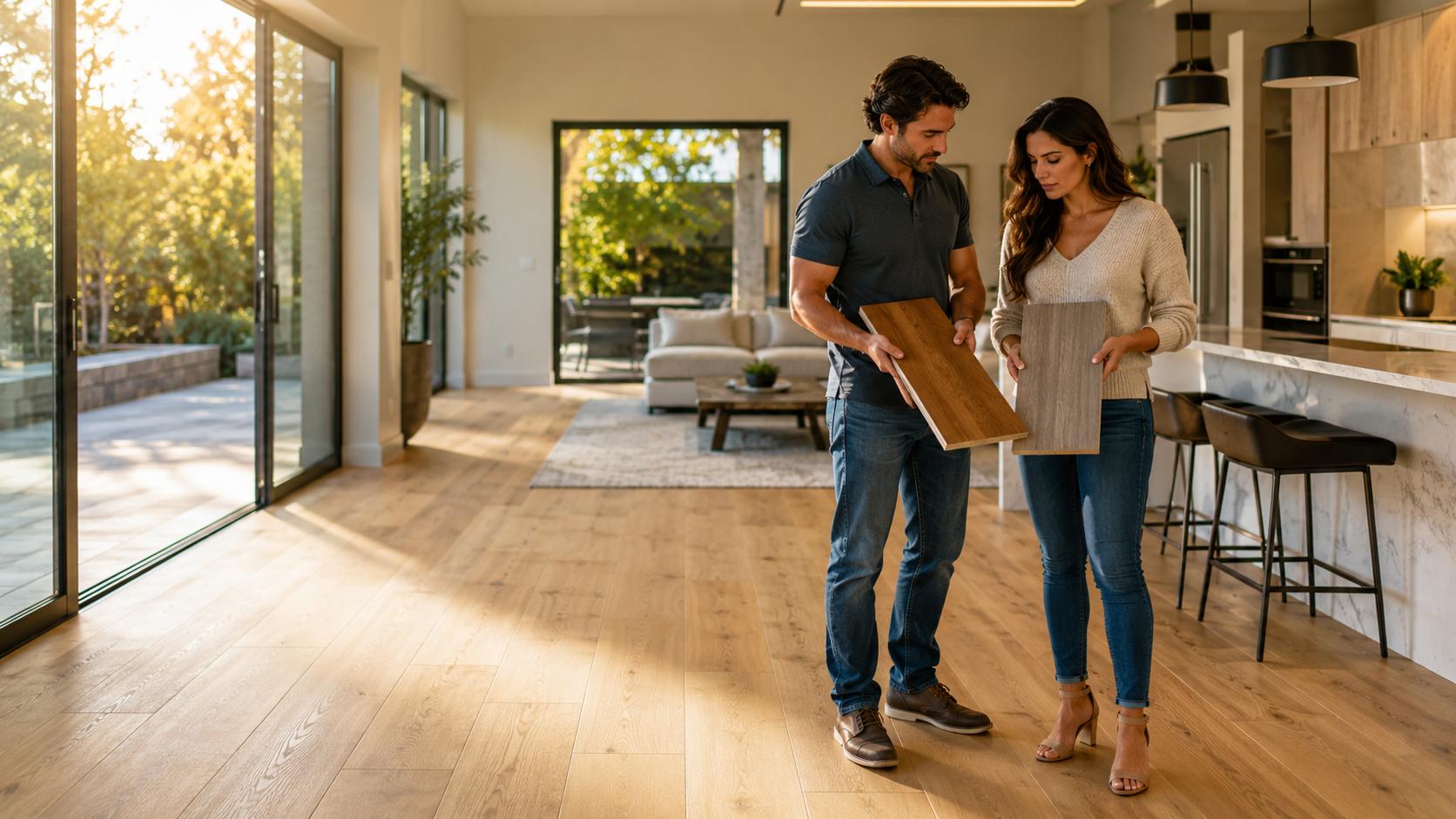
The best way to make the LVP vs hardwood decision is to see both materials in your actual home, in your actual lighting, next to your actual furniture and paint colors. At On Point Flooring, we bring samples of both to your Sacramento home as part of a free in-home consultation.
Seeing a wood-look LVP plank and a genuine hardwood plank side by side in your space makes the visual comparison clear in a way that photos and showrooms cannot replicate. We serve Sacramento, Granite Bay, Folsom, El Dorado Hills, and the surrounding communities.