Best Flooring for Dogs: What Actually Holds Up (and What Doesn't)
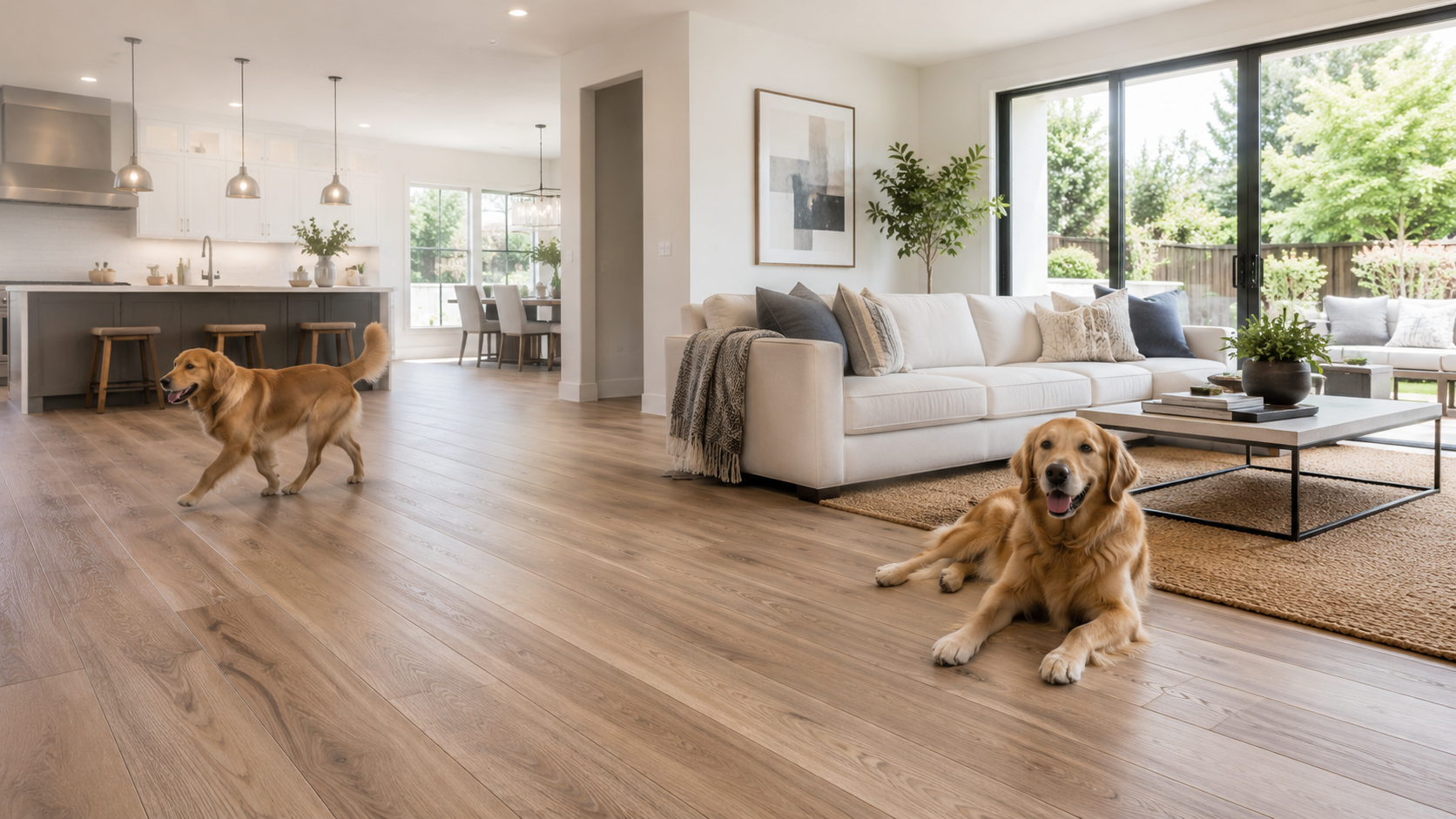
Luxury vinyl plank (LVP) is the best overall flooring choice for homes with dogs because it is 100% waterproof, scratch-resistant on higher-wear-layer products, comfortable underfoot, and the most forgiving surface for pet accidents. Porcelain tile is the most durable option and handles accidents with zero absorption, but it is harder underfoot and less comfortable for pets and people to walk on for long periods. Solid hardwood is the most vulnerable to dog-related damage and is generally not recommended for homes with large or active dogs.
If you share your Sacramento home with one or more dogs, your flooring has to work harder than most. Nails clicking across surfaces, the occasional accident, water bowls getting knocked over, the daily sprint from the back door across the living room -- all of it adds up to conditions that expose the real durability limits of whatever floor is underfoot.
At On Point Flooring, we get asked about dog-friendly flooring constantly, and we give honest answers rather than just promoting whatever is easiest to sell. This guide covers every major flooring type, what dogs actually do to them over time, and which situations call for which material.
What to Look for in Dog-Friendly Flooring
Before ranking the options, it helps to understand what actually matters for homes with dogs. The criteria that separate good and bad flooring for pet households come down to four things:
- Scratch resistance: Dog nails create surface scratches over time. Harder flooring surfaces and products with robust wear layers resist this better than softer materials.
- Waterproof capability: Accidents happen, even with well-trained dogs. Truly waterproof flooring means liquid cannot penetrate the core and cause swelling, warping, or odor that becomes impossible to remove.
- Cleanability: Pet households need floors that clean up completely with standard cleaning products. Surfaces with texture that traps hair or grout lines that absorb liquid are higher maintenance.
- Comfort: Dogs spend a lot of time lying on floors. Hard, cold surfaces like tile are less comfortable for older dogs with joint issues. Flooring with slight cushion underfoot is better for the whole household.
Best Flooring Options for Dogs: Ranked
1. Luxury Vinyl Plank (LVP) -- Our Top Pick
LVP is the flooring we recommend most often for Sacramento pet households, and the reasons are practical rather than promotional. The material is 100% waterproof from surface to core, which means a dog accident that sits on the floor for hours does not penetrate the material or cause lasting damage. The surface is scratch-resistant on products with wear layers of 12 mil or higher, which handles everyday dog nail traffic well. It is comfortable underfoot and significantly warmer than tile, which matters for dogs that lie on the floor for most of the day.
LVP is also the easiest flooring to clean thoroughly. It does not have grout lines to trap hair and debris. It does not absorb pet odors. A damp mop with a pet-safe cleaner handles routine cleaning and a full wet mop handles anything more serious. It installs over existing subfloors in many cases, making it a practical choice for homeowners who want to upgrade without the disruption of full demolition.
The main limitation: LVP cannot be refinished when the surface wears. After 20 to 25 years of serious use, it needs to be replaced rather than sanded and refreshed. In a pet household getting heavy use, budget for a replacement cycle rather than expecting a forever floor.
2. Tile -- Best for Durability and Accidents
Porcelain tile is genuinely impervious to dog accidents, scratches, and moisture. It is the most durable floor surface available and will literally never be damaged by a dog's nails. If ultimate durability and zero absorption are the priority, tile is the answer.
The honest trade-offs are real though. Tile is cold and hard underfoot, which is uncomfortable for dogs with arthritis or joint problems and for people who stand or walk barefoot on it regularly. Grout lines collect hair, dirt, and debris and require more effort to keep clean than a continuous vinyl surface. Tile is also among the more expensive installation options because of the labor intensity involved.
Our recommendation: tile makes excellent sense for mudrooms, laundry rooms, and entry areas where the dog comes in from outside wet and dirty. As the primary living area floor in a home with multiple large dogs, the comfort trade-off starts to matter more.
3. Engineered Hardwood -- Good with Precautions
Engineered hardwood gives you the genuine wood look and warmth that many Sacramento homeowners want, with somewhat better moisture tolerance than solid hardwood. It is a reasonable choice in pet households with dogs that are well-trained, have good nail maintenance, and do not have accidents indoors.
The caveats are meaningful. Engineered hardwood is water-resistant, not waterproof. An accident that sits for any significant time will cause the wood veneer to swell or stain. The surface will show nail scratches over time, particularly with larger breeds. The finish can be refinished one to three times depending on veneer thickness, which gives you some ability to restore the surface after years of pet use. For a single older dog in a home where accidents are rare, engineered hardwood works beautifully. For a home with multiple dogs or a puppy in training, the risk of damage is too high to ignore.
4. Laminate -- Decent Option with Limitations
Laminate offers a wood look at an accessible price point and handles dog nail scratches reasonably well because the surface is a hard resin layer rather than natural wood. The scratch resistance is often better than engineered hardwood, which surprises homeowners who assume a more expensive product is always more durable.
The serious limitation for pet households is moisture. Laminate is not waterproof. The core of a laminate plank is HDF (high-density fiberboard), which swells and warps when it gets wet. An accident that soaks through the surface can cause permanent damage to the plank and the planks adjacent to it. For homes where accidents are a realistic possibility, laminate is a gamble that does not always pay off.
5. Solid Hardwood -- Beautiful but Vulnerable
Solid hardwood is honest about its limitations in pet households. The surface shows scratches. Dog nails leave marks in the finish and eventually in the wood itself. Accidents cause staining and can cause boards to cup or warp if liquid sits or soaks in. Over time, a solid hardwood floor in a home with active dogs will show it.
The counterpoint: solid hardwood can be refinished, which restores the surface. Many Sacramento homeowners with dogs choose solid hardwood, manage the nail length and accident risk carefully, and refinish every several years as part of their home maintenance cycle. The floor still looks beautiful for decades under those conditions. But it requires commitment to pet management that not every household is realistic about. If you have a large breed puppy, we would steer you toward LVP until the training phase is complete.
6. Carpet -- The Honest Assessment
We are not going to tell you carpet is a bad choice in every room of a pet household, because that is not honest. Carpet in bedrooms, particularly for older dogs who sleep on the floor, provides warmth and cushion that hard floors do not. Many homeowners successfully use carpet in lower-traffic bedrooms and hard flooring throughout the main living areas.
The real issue with carpet and dogs is what happens when accidents occur. Even with immediate cleanup, the moisture and protein from urine penetrates through the carpet fibers into the pad underneath and often into the subfloor. Once odor is in the pad, surface cleaning does not address it. Recurring accidents in the same spots create a persistent odor problem that is very difficult to fully resolve without replacing the carpet and pad entirely. If accidents are a regular reality in your home, keep carpet out of the spaces where your dog spends the most time.
Best Flooring for Dogs That Have Accidents
If your dog has frequent accidents, is a puppy in training, or is older and experiencing incontinence, the only flooring category you should seriously consider is truly waterproof. That means LVP or tile, full stop.
The phrase 'waterproof laminate' appears in a lot of marketing material and is worth understanding clearly: most products labeled as waterproof laminate protect against surface spills that are wiped up quickly. They are not waterproof in the same way LVP is, meaning a liquid that sits or seeps into the seams will still reach the HDF core and cause swelling. For households where accidents sit for any amount of time before cleanup, only a product with a fully waterproof core is truly appropriate.
For accident-prone households, we recommend LVP with a wear layer of at least 12 mil, installed with proper adhesive at the seams in high-risk areas to prevent liquid from seeping between planks. This combination handles even heavy accident situations without permanent damage and cleans completely with standard pet odor-neutralizing cleaners.
Best Scratch-Resistant Flooring for Dogs
If scratch resistance is your primary concern, here is how the materials rank honestly:
For homes with large breeds or multiple dogs, we recommend LVP with a wear layer of 20 mil or higher. This tier of LVP handles daily nail traffic from large dogs without showing significant surface wear over its lifespan. Bring your dog's breed and size to your consultation with us -- it genuinely affects which specific products make the most sense.
Flooring to Avoid with Large or Active Dogs
Some flooring categories present specific problems in active dog households that are worth calling out directly:
- Soft or hand-scraped hardwood finishes: These beautiful textured surfaces show dog nail tracking very quickly and are difficult to refinish evenly. The texture also traps hair and debris more than smooth finishes.
- Glossy tile finishes: High-gloss tile is slippery for dogs, particularly on turns and stairs. Dogs that slip repeatedly on slick floors can develop anxiety about certain areas of the home and are at greater risk of joint injuries.
- Thin-wear-layer LVP (6 mil or less): Entry-level LVP is technically waterproof but will show surface scratching quickly in active dog households. Spending slightly more on a 12 to 20 mil wear layer is always worth it.
- Bamboo flooring: Despite its reputation for hardness, bamboo's surface is often more susceptible to scratch damage than domestic hardwoods. We rarely recommend it for pet households.
Frequently Asked Questions
Q: What is the best flooring for dogs in Sacramento?
A: LVP with a 12 mil or higher wear layer is the best overall flooring for most Sacramento households with dogs. It is 100% waterproof, comfortable, scratch-resistant, and easy to clean thoroughly. For maximum durability and zero concern about accidents or scratches, porcelain tile in low-gloss finish is the most resilient option, particularly for entryways and kitchen areas.
Q: Can dogs scratch LVP flooring?
A: Most quality LVP with a wear layer of 12 mil or higher handles everyday dog nail traffic without showing significant scratching. Very large breeds with heavy nails may show some micro-scratching over time on thinner wear layers. We recommend 20 mil wear layer LVP for homes with breeds over 60 pounds or multiple dogs. The surface of LVP cannot be refinished, so the wear layer thickness you choose at installation is the protection you have for the life of the floor.
Q: Is hardwood flooring a bad idea with dogs?
A: Hardwood flooring is not automatically a bad idea with dogs, but it requires realistic expectations and active management. Dogs should have their nails trimmed regularly, accidents should be addressed immediately, and the floor will show wear over time that solid hardwood handles better than engineered hardwood because it can be refinished. For puppies, large active breeds, or dogs with house-training challenges, LVP is a more practical starting point.
Q: What is the most waterproof flooring for pet accidents?
A: LVP and porcelain tile are the only truly waterproof flooring options for pet households. Both have a waterproof core that does not absorb moisture regardless of how long a liquid sits on the surface. LVP is warmer underfoot and more comfortable for pets and people, making it the practical first choice for most living areas. Tile handles even heavier moisture exposure with zero risk.
Schedule a Free In-Home Flooring Consultation in Sacramento
At On Point Flooring, we bring samples to your home so you can see exactly how different materials look in your specific lighting, against your furniture and paint colors, and in the rooms where your dogs spend the most time. There is a real difference between seeing a floor sample in a showroom under fluorescent lights and seeing it in your actual home, and we think it matters.
Our consultations are free, come with no pressure, and include honest recommendations based on your dogs, your lifestyle, and your budget. We serve Sacramento, Granite Bay, Folsom, El Dorado Hills, and surrounding communities.